
The AI That Works Is the AI Nobody Sees: How Harley's Heating & Air Runs on Invisible Automation
Robby Team
June 14, 2026 · 11 min read
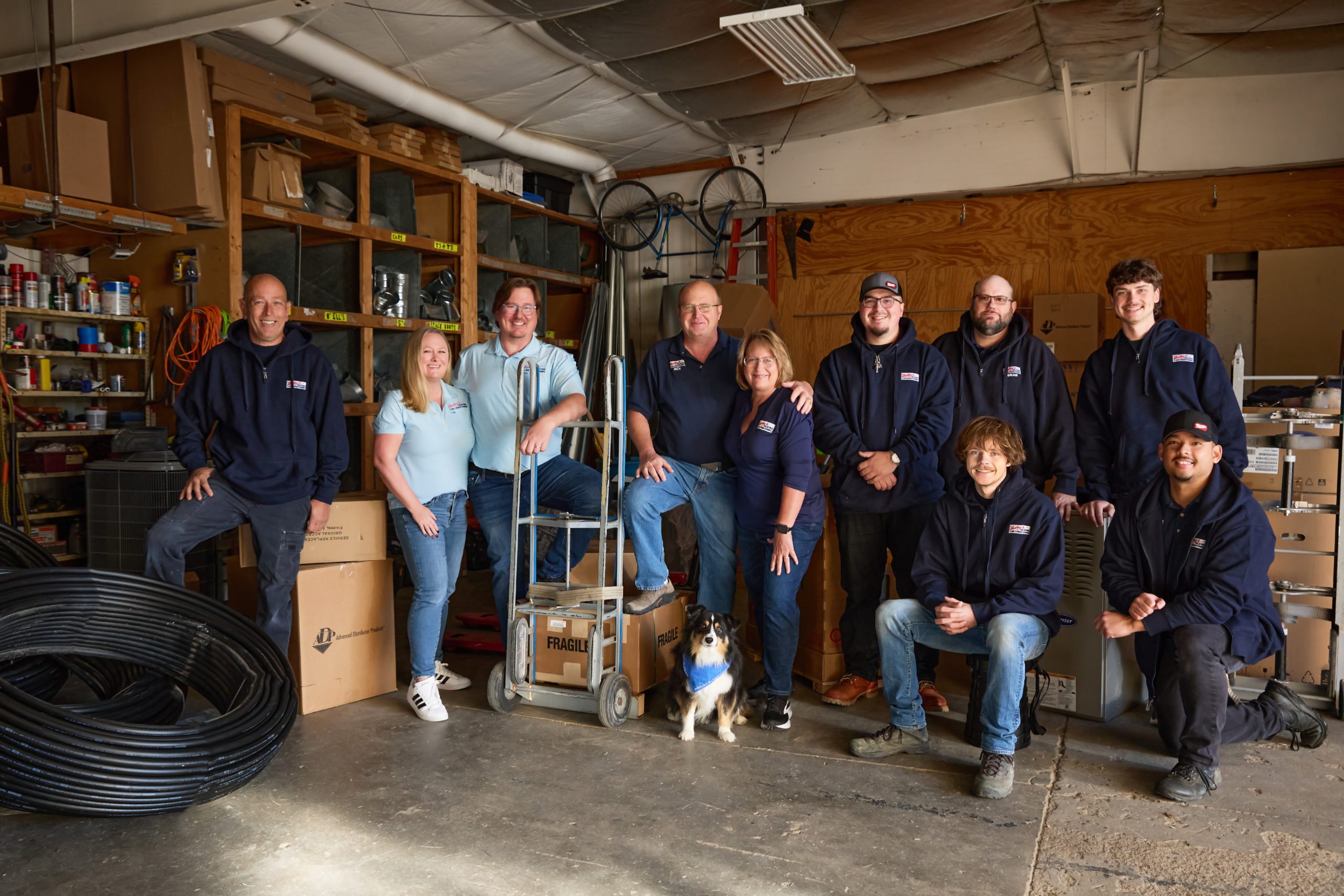
This is the seventh installment of our Home Services Leaders in AI series, where we sit down with operators actually using AI and automation to run their companies, no theory and no hype. (Catch up on the first interview with Sarah at Golden Rule Cleaning, the second with Dave at Glass Therapy Clarksville, the third with Adam at Blanton & Sons, the fourth with Bekka at Advanced Air Conditioning + Heating, the fifth with Kara at Air Repair Pros, and the sixth with Tim at IRBIS.)
Harley's Heating and Air Conditioning is an HVAC company in Lincoln, Nebraska. Matt Shortridge's grandfather started it, his father Rick and mother grew it, and for roughly 40 years it ran on handwritten paper tickets in folders before moving to software. Matt didn't plan to run it. He went off and built a career in structural biology, the world of protein structures, molecular-folding software, and awk scripts, then came back to take the reins of the family business. Today Harley's is about 15 people, 10 of them technicians, on ServiceTitan since 2023 and an early adopter of the ServiceTitan MAX program. Matt is genuinely pro-AI. He's also the most honest operator we've talked to about where it pays off and where it doesn't.
Backend, Not Front Desk
Matt has a clean rule for which AI survives in his shop, and he learned it the hard way. "Some of it is my own leadership style," he says. "I saw the excitement. I was like, we're going to do this, let's run with it. Anticipating everybody else would immediately see the value in it. And they don't." Hand a technician a new tool and what they see isn't the upside. "They see more buttons I have to click, more things I have to look at, more that's already complicating my day." The front-end tools he was excited about got rejected.
The automation that worked was the kind nobody could see. "The stuff that's worked is the stuff that's on the backend that nobody has to see. Nobody has to touch, nobody has to interact. That stuff seems to be working. I don't have to develop change-management plans around it. It just works. Set it, forget it, and the guys have no issue with it." That single distinction, invisible versus hands-on, predicts which AI sticks at Harley's better than anything else.
The stuff that's worked is the stuff on the backend that nobody has to see. Set it, forget it, and the guys have no issue with it. But if it's on the front end, they don't want to learn anything at all.
— Matt Shortridge, Harley's Heating & Air
The Scientist Who Came Home
Matt's perspective is shaped by an unusual path into the trade. He grew up in the company, not just the industry but this exact company, watching his grandfather, father, and mother run it. Then he left for a career in hard science: structural biology, protein folding, academic software like the molecular program XPLOR-NIH, the kind of work where you write your own scripts to parse and reorganize a data set because the tools aren't user-friendly. Global warming was part of what pulled him back. "Back-of-the-envelope calculations, like, okay, global warming's happening, maybe it's the right time to move back."
That background leaves him in two worlds at once. "On one hand, the guys know that I kind of have that cultural fit. At the same time, I don't. I also have that educated, quote-unquote, cultural background." He's the owner's kid who grew up around the vans and also the PhD-track scientist trying to convince a 17-year-veteran technician that there's a faster way to pull a vacuum. What attracted him to AI in HVAC was, of all things, the mess. "We have so many different inputs between customers and business owners and technicians and vendors. It's not a nice, simple, clean data set like a crystal structure of a protein where you can build AlphaFold around. You have real people, and they surprise you."
All-In on ServiceTitan
Where Tim at IRBIS buys the best point solution for each job and wires them into ServiceTitan, Matt went the opposite way: nearly everything Harley's runs lives inside the ServiceTitan package, and he got into the MAX program early, one of a roughly 50-company group of early adopters. His take on the platform is also contrarian. Most operators we talk to either tolerate ServiceTitan because they have to or actively dislike it. Matt likes it. "It's incredibly complicated. It is a nightmare. But it's really, really good at what it does. If you know one module of it, you can easily apply the same logic to the entire program." Coming from academic software, the complexity doesn't faze him.
What he values most about MAX isn't a single feature. "You get access to all their tools all at once. It's not sprinkled in. And the amount of support they've been providing is way more valuable than the amount of money you spend on it." One thing Matt has noticed across the category, not about any one vendor, is that purpose-built diagnostic assistants haven't yet caught up to general-purpose models for field troubleshooting. He'll often get a sharper answer to a technical error code out of Claude or ChatGPT than out of a bundled trade-specific tool, especially on fast-moving topics like the recent refrigerant changes. Different gap than the one Kara closed at Air Repair Pros by finding a voice agent callers can't tell from a human, but the same lesson: the AI built into a platform isn't automatically the best AI for every job.
The Dispatch Engine That Doubled the Calls
The headline backend win is Dispatch Pro. "They seem to have solved the traveling salesman problem," Matt says, "which is pretty much what we're dealing with. That's what attracted me to the software." The system optimizes on two axes at once: location, and which technician belongs at which customer's home. "It's both a skill thing, somebody able to diagnose, but also somebody that can bridge that comfortability gap with the customer." In the trades you sometimes need the right tech to deliver a hard set of three messages, here's your problem, here's the fix, here's the cost, and Dispatch Pro helps put that person in front of that homeowner.
Almost Double the Calls, Same Crew
Since moving to ServiceTitan's Dispatch Pro, Harley's is getting in almost double the number of service calls it handled the year before, without adding technicians. The system reshuffles the dispatch board in real time, so a higher-priority call automatically reorders the day to put the right tech at the right home.
There was a speed bump. The crew was used to a fixed schedule they could see in advance, and Dispatch Pro reshuffles the board in real time when a higher-priority call comes in. But because it runs in the background rather than asking a technician to learn a new screen, they adapted fast. It's the rule in action: the automation that doubled throughput is the one nobody has to operate.
What Lisa Built, and What Matt Tests on His Dad
The office side of the backend is largely his wife's work. Lisa Shortridge was on PayPal's internal AI tool development team before a restructuring last year, and Matt counts the timing as a win for the company. "I was happy that she got let go, because now we got somebody in. She's been instrumental." She set up the AI voice and text herself. "It's amazing to watch what it can do. It fires back and forth, and a lot of the customers don't even realize they're talking to an AI, or they don't care, and it just immediately books." Same shape as the named front-desk agents Bekka runs at Advanced Air: between automated marketing, automated intake, and automatic dispatch, Matt says jobs now go out the door without a single person having touched them.
Matt's own builds lean customer-facing, and one experiment sticks out. He's been feeding Claude blueprints for not-yet-built houses and asking it to size the system, then checking the answer against the toughest reviewer he has: his father, Rick, who has been doing manual load calculations for 50-plus years. "He's like, oh, I'm going to need a two-and-a-half-ton system with this. And the answer from Claude is, you need about a two-and-a-half-ton system for this." Matt's verdict is half joke, half genuine benchmark.
He is my manual J. I don't need a manual J. I need a Rick Shortridge.
— Matt Shortridge, Harley's Heating & Air
He's quick to add the caveat a scientist would: a load calc is only how much heat a house absorbs, not what the equipment, ductwork, and airflow actually need. "These are interconnected systems. You can't just bring it down to one number." The AI matched the veteran's gut on the easy part. The judgment around it still lives with the 50-year tech.
The Honest Part: Where the ROI Isn't
Here's what sets this interview apart from the rest of the series. Most operators we profile lead with a number that went up. Matt leads with one that hasn't. Six or seven months into the full MAX stack, he can't find the revenue lift he was promised. "We're getting more calls done. We're getting through calls faster. But my revenue is not growing at the scale that they're promising." The catch is mix: "We're getting a lot more lower-dollar jobs done rather than high-dollar jobs." More activity, faster activity, but not yet more money, and he's layering on the cost of the software to boot. He's not bitter about it, he likes the ServiceTitan team, but he won't pretend the magic revenue curve has appeared.
His other worry is sameness. "If everybody's using the same AI, every company becomes indistinguishable. The customer has no idea who anybody actually is anymore." He can spot AI-generated work on sight, the easy tells, the way everything looks the same, and he's wary of a market where every shop sounds like every other shop. His counter-move is deliberately analog: "We featured my mom in one of the local TV ads to make sure that, no, we're still real." Same instinct Adam protects at Blanton & Sons, where staying a recognizable family business is the point, not a constraint to automate away.
If everybody's using the same AI, every company becomes indistinguishable. The customer has no idea who anybody actually is anymore.
— Matt Shortridge, Harley's Heating & Air
He's also clear-eyed about where consumer AI does real damage. A homeowner pointing a chatbot at their own system "is going to read something, and they're going to do what they read, and they could, and have already, broken their thermostat, hurt their house." A technician who already understands the system can catch a wrong answer; a homeowner can't tell a good answer from just an answer. The bid market scares him for the same reason: customers who have no idea what a two-ton versus a two-stage system is are pasting $10,000 to $20,000 quotes into a generic AI and asking which one's best. "Outside of lawyers, we're like the last people that people want to see," he says, and AI that pretends to make a huge, opaque purchase simple can leave them worse off, not better.
For all that, his vision for the technology is expansive. The thing he's most excited about isn't a chatbot, it's smart glasses, real-time live-action tech support in a technician's field of view. "I could take a relatively inexperienced but smart individual, supplement their knowledge with the AI. We train them on how to use the AI rather than train them on how to do the work. We could grow our workforce incredibly fast that way." And he frames the whole thing to his crew as protection, not threat: the shift is coming in the next 18 to 24 months, and he'd rather be the safe place his long-tenured techs learn it than watch them get left behind.
Matt's Framework
- Put AI where no one has to touch it. Backend automation gets adopted silently; tools you hand a technician get rejected as more buttons to click and more ways to complicate the day.
- Don't mistake more activity for more revenue. Faster, higher-volume call handling is real, but count the dollars and the software cost honestly before you believe the magic lift is here.
- Keep a human in the brand. If every shop runs the same AI, every shop becomes indistinguishable, so protect the things, like your mom in the TV ad, that prove you're still real.
- Let the expert read the AI, not the novice. A technician who knows the system can catch a wrong answer; a homeowner following a chatbot can break their house.
- Use AI to upskill people fast, not to replace the trade. Train smart new hires on how to use the tools rather than on how to do the work, and you can grow a workforce quickly.
- Get your team in front of it now. The shift is coming in 18 to 24 months; be the safe place your people learn it instead of letting them get left behind.
The Bottom Line
Matt Shortridge is the rare operator who is both an early adopter and a skeptic about his own results. He runs a multi-generational family shop in Lincoln, went all-in on ServiceTitan's MAX program, has a former PayPal AI builder running his phones, and tests Claude against his 50-year-veteran father for fun. He's exactly the kind of person you'd expect to oversell AI. Instead he gives you the unglamorous truth: the technology has made Harley's faster and busier, and it hasn't yet made it richer.
The throughline is his backend rule. The AI that doubled his call volume did it without a single technician learning a new screen, and the AI he was most excited to hand his crew is the AI that flopped. The wins are invisible by design. Until the tools get good enough to live in a technician's hands without slowing them down, Matt's bet is the same one that's worked so far: automate the parts nobody sees, keep a real person on the parts they do, and don't confuse a busier calendar with a better business.
Ready to Automate Your Home Services Business?
If Matt's instinct rings true, that the AI worth keeping is the AI your team never has to fight, that's the philosophy behind Robby. We help HVAC, plumbing, and electrical companies automate the sales and back-office work that drags on revenue: AI-powered estimate generation, automated documentation, manual J and load calculations, follow-up, and clean integrations across ServiceTitan, HouseCall Pro, and the rest of the stack. The goal is wins that show up in the numbers, not just the activity log.
Book a free demo and we'll walk through your specific workflow and show you where the biggest wins are.
Home Services Leaders in AI
This article is part of our video series interviewing home-services business owners and operators who are leading the charge with AI and automation. Follow along on our blog and LinkedIn for new interviews each month. Got a story to share or know someone we should talk to? We'd love to hear from you.
Read Next
Single Source of Truth: How Southern Air's Team Built a 20-Year Software Stack — Then Supercharged It with Claude
11 min read

Never Trust the Sales Call: How IRBIS Stress-Tests Every AI Tool Before It Touches San Jose
11 min read
Ready to automate your HVAC documentation?
Join hundreds of HVAC companies using Robby to boost revenue and reduce callbacks.
Book a Demo